Michael Hahn wins the 2026 Heinz Maier-Leibnitz Prize
Michael Hahn, Professor of Computational Linguistics at Saarland University and academic fellow of the Zuse School ELIZA, has been awarded the 2026 Heinz Maier-Leibnitz Prize by the German Research Foundation (DFG). The prize is considered one of Germany’s most prestigious distinctions for researchers in the early stages of their careers and is awarded to only ten scientists nationwide each year.
 © Zuse School ELIZA
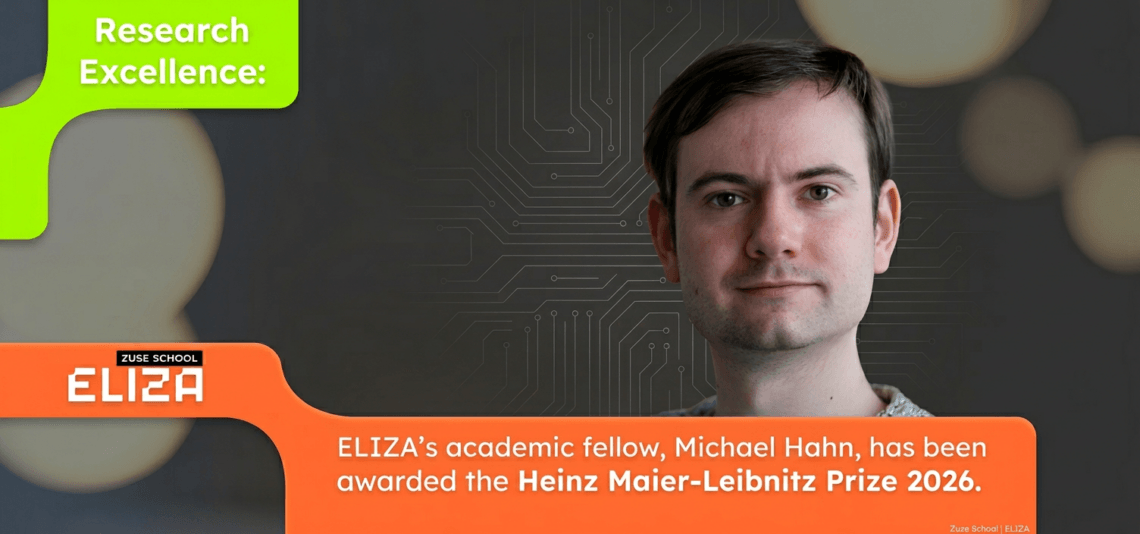
Hahn is a tenure‑track professor in the Departments of Language Science and Technology and Computer Science at Saarland University, where he leads the Language, Computation and Cognition Lab at the Saarland Informatics Campus. He is also an ELIZA academic fellow, contributing to the school’s mission of connecting cutting‑edge machine learning research across German universities.
Large language models (LLMs) have become central to many applications, but they can still fail dramatically on tasks that require precise logical reasoning: calculations may be wrong, sequences misordered, or the model may hallucinate figures and quotations. Hahn’s research combines machine learning and computational linguistics to understand why these systems go wrong, even when they appear highly capable.
Using mathematical methods, he analyses the transformer architecture that underpins today’s major LLMs and shows that transformers systematically struggle with so‑called “sensitive” functions—tasks where every part of the input can affect the correct output, so that even changing a single character can flip the result. These findings make it possible to predict where current architectures are robust and where they are fundamentally fragile, especially in logic‑sensitive applications.
As AI systems are increasingly embedded in scientific work, public institutions, and everyday tools, understanding their structural limitations becomes a matter of epistemic and practical importance. Hahn’s work does not simply aim to improve model performance in an engineering sense; it clarifies the theoretical boundaries of what current architectures can genuinely be trusted to do, and where new designs or safeguards are needed.
The Heinz Maier-Leibnitz Prize comes in addition to Hahn’s Emmy Noether research group funded by the DFG, which supports his team’s investigations at the interface of machine learning and computational linguistics over the coming years. Together, these recognitions underscore the central role that foundational research on LLM architectures will play in the next phase of AI development.
Further details about the prize and Hahn’s research can be found in the official press release from Saarland University, available here.
See also...
News & Events
- 14.07.2026
- News
ELIZA’s fellow receives an ERC Advanced Grant for LearningOFDFT
The grant supports a new Scientific AI project on precise and stable molecular energy calculations using an orbital-free approach.
- 25.06.2026
- Event
2026 Berlin Summer School on Artificial Intelligence and Society
The Zuse School ELIZA is pleased to announce its participation in the 2026 Berlin Summer School on Artificial Intelligence and Society, co-organized together with BIFOLD Graduate School, the Learning and Intelligent Systems lab, and the Weizenbaum Institute.
- 02.06.2026
- Event
ELIZA’s Pre-ICML Poster Sessions 2026
As ICML 2026 approaches, the Zuse School ELIZA is bringing its community together with a series of Post-CVPR Pre-ICML Poster Sessions at three locations across Germany. These events are a cornerstone of ELIZA's mission: creating spaces where PhD students, postdocs, and faculty from different institutions can exchange ideas, strengthen connections, and celebrate high-impact research.