ELIZA Fellow Georgia Chalvatzaki Awarded the Alfried Krupp Prize 2025
What does it mean for a robot to learn with us, not merely for us? This is more than a technical challenge—it is a question about how we design intelligent systems that recognize human needs, contexts, and dignity.
 © Prof. Georgia Chalvatzaki / Katrin Binner
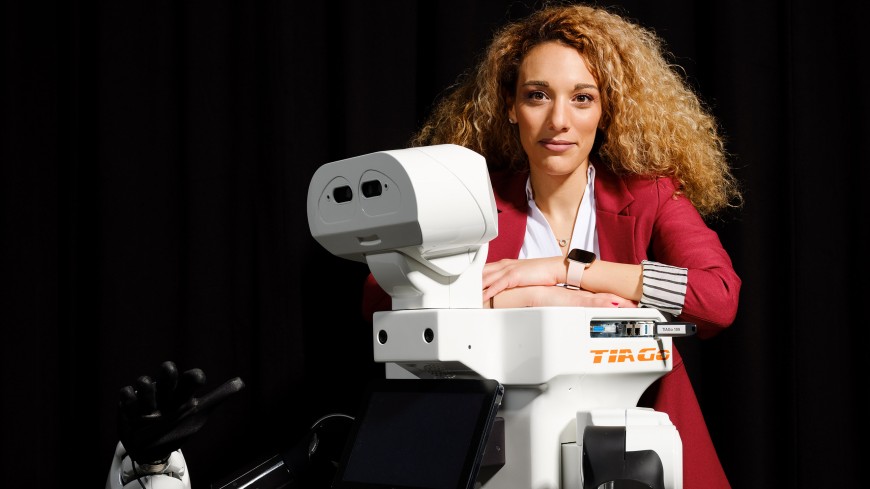
Picture: Katrin Binner Computer scientist Georgia Chalvatzaki receives the Alfried Krupp Prize 2025, endowed with 1.1 million euros.
ELIZA fellow Prof. Dr. Georgia Chalvatzaki (TU Darmstadt) has been awarded the prestigious Alfried Krupp Prize 2025, endowed with €1.1 million. One of Germany’s most significant scientific distinctions, the prize honors outstanding early-career researchers in their first professorship and underscores the societal relevance of their work.
Since 2023, Chalvatzaki has held the Professorship for Interactive Robot Perception and Learning at TU Darmstadt, where she leads the PEARL Lab. Her research advances robots that learn in real time through interaction—with environments and, crucially, with humans. This human-centered robotics approach reframes autonomy as collaboration: machines that adapt to us, rather than asking people to adapt to machines. The implications are wide-ranging, from more attentive healthcare support and responsive logistics to robust, sustainable agriculture.
Her trajectory reflects both scientific rigor and community impact. In 2024, Chalvatzaki received an ERC Starting Grant and was named an ELLIS Scholar in the European Lab for Learning and Intelligent Systems, aligning her work with Europe’s leading efforts in machine learning. As an ELIZA fellow, her research resonates deeply with our commitment to interdisciplinary, responsible AI that is not only performant but socially attuned.
At its core, Chalvatzaki’s work is a meditation on learning as shared practice: perception as dialogue, adaptation as care, and intelligence as something distributed across humans and machines. The Alfried Krupp Prize recognizes this vision and the promise it holds for safer, more responsive, and genuinely helpful robotic systems.
See also...
News & Events
- 23.01.2026
- News
For Women in Science 2026 Award
ELIZA strongly encourages female doctoral candidates and early-career researchers to apply for the prestigious "For Women in Science 2026" award. Four outstanding women scientists will each receive €25,000 to advance their research careers. Deadline: February 21, 2026
- 12.12.2025
- News
ELIZA Fellow Klaus-Robert Müller Awarded 2026 Leibniz Prize
ELIZA Fellow Klaus-Robert Müller wins the Leibniz Prize 2026 for his contributions to ML theory and its application in the natural sciences.
- 12.11.2025
- News
What happens to AI when we stop thinking on flat ground?
A new AI for Good webinar features ELIZA Academic Fellow Prof. Dr. Daniel Cremers (TUM) speaking on “Convolutional networks beyond the Euclidean space”.