News & Event Type: Event
 © Adobe Stock/InfiniteFlow

Under the theme “Responsible design of AI-driven autonomous systems”, the Summer School will take place from 14–17 September 2026 at BIFOLD on the TU Berlin Campus Charlottenburg in Berlin, Germany. It brings together researchers and practitioners to explore how AI systems that act autonomously can be designed to be robust, verifiable, explainable, secure and aligned with societal values.
The programme focuses on fundamental questions at the intersection of autonomous systems, trustworthy machine learning and robotics, with applications in critical domains such as healthcare and scientific infrastructures. Participants will engage with both technical approaches to responsible AI system design and broader perspectives from digitalization research, ethics and governance.
The 3.5‑day curriculum combines:
-
Keynotes by leading experts on machine learning, data management, robotics and the societal implications of AI
-
In-depth lectures on state-of-the-art methods and projects related to autonomous systems
-
Hands-on sessions offering practical tools and interactive formats
-
Excursions, poster sessions and networking opportunities to foster interdisciplinary exchange and collaboration
The Summer School is designed primarily for doctoral and postdoctoral researchers from the Weizenbaum Institute, the Learning and Intelligent Systems lab, the network of German Centres of Excellence for AI (BIFOLD, DFKI, Lamarr, MCML, ScaDS.AI, and TUE.AI), and from other universities and research institutes who are passionate about machine learning, data management, robotics, and the societal impact of AI. Interested Master’s students in their final year are also warmly invited to apply.
There is no participation fee. Travel and accommodation costs are not covered; coffee and lunch breaks will be provided. ELLIS PhD students may apply for travel grants to support their participation.
-
Location: BIFOLD, Technische Universität Berlin, Franklinstr. 28–29, 10587 Berlin
-
Dates: 14–17 September 2026
-
Application deadline: 30 June 2026
For more information on the programme, speakers and organisational details, and to apply, please visit the official Summer School website.
Three Cities, One Community
This year, ELIZA is proud to co-organize poster sessions in Darmstadt, Munich, and Freiburg — reflecting the school’s truly trans-institutional character.
On June 16, HessianAI in Darmstadt will host the flagship session, jointly organized by the ELLIS Unit Darmstadt, the Zuse School ELIZA, and HessianAI. Researchers are invited to present their recent work from top-tier venues such as CVPR and ICML. The event runs from 14:00 to 16:00, with networking before and after. Attendance is open to PhD students, postdocs, and faculty — registration is required by June 5 via the sign-up form.
On June 23, the Munich session will take place as part of the Munich AI Day, organized in collaboration with MCML (Munich Center for Machine Learning). ELIZA PhD students from partner sites are warmly invited to take advantage of a limited number of poster slots — a wonderful opportunity for cross-site visibility. To register, use the code ELIZA on Eventbrite. More details at: https://mcml.ai/events/2026-06-23-munich-ai-day/
On June 29, IMBIT at the University of Freiburg (Georges-Köhler-Allee 201, 79110 Freiburg) will host the third session, co-organized by the ELLIS Units Freiburg and Darmstadt together with the Zuse School ELIZA. The event runs from 15:00 to 18:00 and will be followed by a BBQ. Researchers are welcome to present work published within the past eight months at a top-tier A/A* conference — bring your poster printed, no format requirements. Registration is open via the sign-up form.
Why These Events Matter
The Pre-ICML Poster Session format is more than a rehearsal for conference presentations. It is a deliberate act of community-building — a moment for the ELIZA network to slow down, look across disciplinary and institutional boundaries, and discover shared directions in machine learning research. From computer vision to robot learning, from NLP to interdisciplinary applications, these sessions embody what ELIZA stands for: excellence, openness, and collective intelligence.
We look forward to seeing the breadth and depth of our community’s work on display. Bring your posters, your curiosity, and your colleagues!
For questions, contact: info@eliza.school
 © Zuse School ELIZA
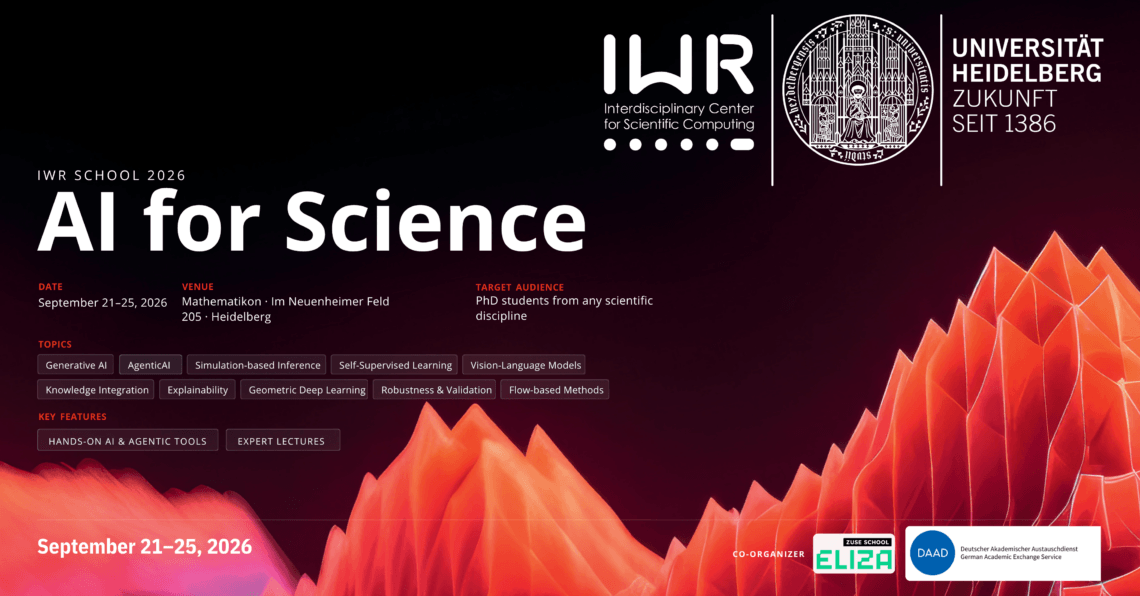
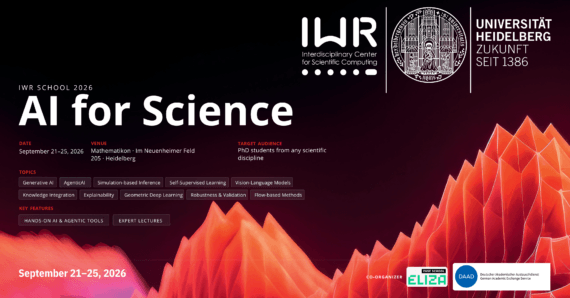
From September 21–25, 2026, the Zuse School ELIZA will co-organize the IWR School 2026: AI for Science, hosted by the Interdisciplinary Center for Scientific Computing at Heidelberg University. This week-long program at Heidelberg’s Mathematikon brings together doctoral researchers and early-career scientists eager to bridge the conceptual and practical gap between artificial intelligence and scientific discovery.
The school is co-organized by Prof. Dr. Carsten Rother, Professor at Heidelberg University and ELIZA Fellow, whose research spans computer vision and machine learning. His direct involvement signals the school’s commitment to rigorous, research-driven pedagogy, not a passive introduction to AI tools, but an active encounter with their underlying principles.
The curriculum spans the frontiers of contemporary AI, generative models, agentic systems, simulation-based inference, vision-language frameworks, explainability, and causal reasoning, each explored through hands-on sessions designed for scientists working across physics, neuroscience, biology, medicine, and climate science.
Among the speakers is Prof. Dr. Lena Maier-Hein, ELIZA Fellow and leading researcher in AI-driven medical image analysis at the German Cancer Research Center (DKFZ). Her work exemplifies how responsible, transparent AI can reshape scientific research without sacrificing epistemic rigor or ethical accountability.
Applications are open to PhD students from any scientific discipline
Registration deadline: June 15, 2026.
Location: Heidelberg, Germany — Mathematikon.
Dates: September 21–25, 2026.
👉 Apply here: https://lnkd.in/d9UimmE7
 © Nathan Dreessen

This significant gathering will bring together participants from all three Konrad Zuse Schools of Excellence in Artificial Intelligence: ELIZA (Darmstadt), SECAI (Dresden), and relAI (Munich). The event will feature prominent keynote speakers from academia and industry, interactive sessions focusing on collaborative AI research, and specialised tracks exploring the latest advances in machine learning methodologies and applications.
Participants will have the opportunity to present their research, receive feedback from peers and mentors, and establish cross-institutional partnerships. Panel discussions will address critical topics such as reasoning in AI. The event represents an important milestone in our joint efforts to advance AI education and research in Germany. As one of the DAAD-funded graduate schools dedicated to cultivating international AI talent at Master’s and PhD levels, ELIZA remains committed to fostering excellence and innovation through high-quality research, interdisciplinary collaboration, and international knowledge exchange.
More details about the programme, registration requirements, abstract submission deadlines, and confirmed speakers will be announced in the coming months on our website and social media channels.
The day began with structured discussions among the 20 participating students, covering various aspects of machine learning and artificial intelligence – from technical applications such as computer vision and natural language processing to ethical considerations including algorithmic bias and responsible AI development. The students exchanged perspectives on the future of AI in healthcare, environmental science, and autonomous systems, fostering a rich intellectual environment.
Following these discussions, participants embarked on a guided tour of the magnificent Heidelberg Castle, where they explored centuries of German history – from Renaissance architecture to royal intrigue and regional conflicts. The tour guide provided fascinating historical context about the castle’s significance in the Thirty Years’ War and its role in German cultural identity. Taking advantage of the festive season, participants then explored Heidelberg’s charming Christmas markets, sampling traditional German treats.
This thoughtfully designed event successfully combined academic networking with cultural immersion, creating lasting connections among participants.
The event in Darmstadt attracted approximately 120 participants, including 20 ELIZA students who showcased their cutting-edge research on topics ranging from generative AI and deep learning to reinforcement learning and computer vision.
The poster session provided an excellent platform for meaningful scientific exchange, with attendees engaging in detailed discussions about methodologies, experimental results, and potential applications of the presented research.
As part of the broader ELLIS Pre-NeurIPS Fest 2024, this Darmstadt session was one of many events organised by ELLIS sites across Europe in preparation for the prestigious NeurIPS conference – highlighting ELIZA’s commitment to promoting excellence in AI research and strengthening the European AI community.