News & Event Type: News

What does it take to stand at the crossroads of language and artificial intelligence? For Iza Škrjanec, a doctoral researcher at Zuse School ELIZA (Konrad Zuse School of Excellence in Learning and Intelligent Systems), the answer begins with curiosity, and a willingness to ask the questions that don’t yet have answers.
Iza was recently featured in INGenie, the magazine of the German Academic Exchange Service (DAAD), in an in-depth interview that traces her academic path, her research at ELIZA, and her experience as an international researcher in Germany. The interview offers an inspiring look at how young scientists navigate the intersection of linguistics, cognitive science, and machine learning, fields that are increasingly converging at the frontier of modern AI.
As part of ELIZA’s cohort of doctoral fellows, Iza embodies the school’s core mission: to cultivate the next generation of AI researchers through rigorous interdisciplinary training, international collaboration, and an environment where intellectual courage is valued above perfection. Her work touches on the ways machines process, understand, and generate language, a question that sits at the very heart of today’s most transformative AI systems.
👉 Read the full interview in INGenie magazine (page 42):
https://online.fliphtml5.com/azcn/096-805_INGenie_2026-9JcC/#p=42

Hahn is a tenure‑track professor in the Departments of Language Science and Technology and Computer Science at Saarland University, where he leads the Language, Computation and Cognition Lab at the Saarland Informatics Campus. He is also an ELIZA academic fellow, contributing to the school’s mission of connecting cutting‑edge machine learning research across German universities.
Large language models (LLMs) have become central to many applications, but they can still fail dramatically on tasks that require precise logical reasoning: calculations may be wrong, sequences misordered, or the model may hallucinate figures and quotations. Hahn’s research combines machine learning and computational linguistics to understand why these systems go wrong, even when they appear highly capable.
Using mathematical methods, he analyses the transformer architecture that underpins today’s major LLMs and shows that transformers systematically struggle with so‑called “sensitive” functions—tasks where every part of the input can affect the correct output, so that even changing a single character can flip the result. These findings make it possible to predict where current architectures are robust and where they are fundamentally fragile, especially in logic‑sensitive applications.
As AI systems are increasingly embedded in scientific work, public institutions, and everyday tools, understanding their structural limitations becomes a matter of epistemic and practical importance. Hahn’s work does not simply aim to improve model performance in an engineering sense; it clarifies the theoretical boundaries of what current architectures can genuinely be trusted to do, and where new designs or safeguards are needed.
The Heinz Maier-Leibnitz Prize comes in addition to Hahn’s Emmy Noether research group funded by the DFG, which supports his team’s investigations at the interface of machine learning and computational linguistics over the coming years. Together, these recognitions underscore the central role that foundational research on LLM architectures will play in the next phase of AI development.
Further details about the prize and Hahn’s research can be found in the official press release from Saarland University, available here.
We are now accepting applications for the Zuse School ELIZA Master’s scholarships for the Summer Semester 2026.
ELIZA supports research-oriented Master’s students in AI who are enrolled, or about to enroll, in a Master’s programme at one of our network universities. Through funding from the German Academic Exchange Service (DAAD) with resources from the German Federal Ministry of Education and Research (BMBF), and coordination by TU Darmstadt, ELIZA offers an excellent environment for developing as an AI researcher.
If you are passionate about AI and eager to work in an international research network, we encourage you to submit your application. Applications for the Summer Semester 2026 are open until 25 April 2026.
This is a meaningful opportunity for ELIZA students to present their research to an international audience, exchange ideas with doctoral researchers from across Europe, and engage with the wider AI research community. As a co-organising institution, ELIZA’s involvement reflects our commitment to connecting students with high-quality academic forums at a European level.
We encourage all eligible students to consider participating. Registration is now open.
ELIZA Academic Fellow Joins UN’s New AI Scientific Panel
We’re proud to share some exciting news from the global AI research community: Prof. Dr. Bernhard Schölkopf, ELIZA Academic Fellow and ELLIS member, has been selected as one of 40 experts worldwide to join the United Nations’ Independent International Scientific Panel on AI.
Selected from a pool of more than 2,600 applicants, the panel members represent the brightest minds in AI research and will play a pivotal role in shaping UN AI governance frameworks and innovation initiatives. The appointment is a testament to Prof. Schölkopf’s exceptional contributions to the field and his standing as one of the world’s foremost AI researchers.
We also extend our congratulations to Piotr Sankowski (University of Warsaw) and other ELLIS network members who were selected — a proud moment for the entire European AI research community.
This recognition highlights the growing influence of the ELLIS and ELIZA networks on the global AI policy stage. We look forward to the impactful work this panel will produce.
At ELIZA, we recognize that artificial intelligence research remains significantly gender-imbalanced, and we are at the forefront of leveraging the gap through targeted support for underrepresented groups. Our Master’s program actively recruits and supports women and other underrepresented groups in AI and machine learning research. We believe that diverse perspectives are essential for responsible AI development, and we actively encourage our community to pursue every available opportunity for advancement.
About the For Women in Science Award
The “For Women in Science” program represents a successful global partnership between UNESCO and L’Oréal that has been promoting women in science since 1998. In Germany, this initiative is supported by the German Commission for UNESCO, L’Oréal Deutschland, and the German Humboldt Network, offering four awards of €25,000 each to exceptional female researchers.
Eligibility for ELIZA Community Members
ELIZA doctoral students and alumni may be eligible if they are:
-
Doctoral students in their final year
-
Postdocs, postdoctoral researchers, or junior professors within four to six years following their doctorate
-
Holding a valid employment contract or scholarship at a German university or public research institution (minimum 50% full-time position) with at least twelve months remaining
The award welcomes researchers in natural sciences, engineering, geosciences, agricultural sciences, and medicine, with interdisciplinary and transdisciplinary research profiles strongly encouraged —making it particularly relevant for AI and machine learning researchers working at interdisciplinary boundaries.
How to Use the €25,000 Award
Winners have flexibility in using the prize money according to a pre-submitted concept. Funding can support:
-
Research projects and equipment purchases
-
International research stays and collaborations
-
Childcare and domestic help
Female scientists with children are expressly encouraged to apply, and among equally excellent applicants, preference is given to those with children.
Why This Matters for ELIZA
This award aligns perfectly with ELIZA’s mission to support women in advancing their research careers in technical fields. By encouraging our community members to apply, we continue our commitment to not just opening doors, but ensuring our scholars have the resources to walk through them and lead the next generation of AI research.
Application Deadline
Applications must be submitted by February 21, 2026.
For complete information and to apply, visit the For Women in Science Germany website.
Prof. Dr. Daniel Cremers—ELIZA Academic Fellow and Chair of Computer Vision and Artificial Intelligence at the Technical University of Munich—has built a career at the intersection of rigorous mathematics, computer vision, and real‑world impact. From early work on shape analysis and optical flow to award‑winning contributions in medical imaging and robotics, his research consistently asks how geometry can deepen what machines can perceive and infer.
In his recent appearance in the AI for Good From Molecules to Models series, Cremers brings this perspective to the webinar “Convolutional networks beyond the Euclidean space.” Rather than treating convolutional networks as a solved chapter of deep learning, he invites the audience to consider what happens when data lives on graphs, manifolds, or other non‑Euclidean structures—and why this matters for applications like medical diagnosis and molecular science.
ELIZA Fellow Klaus-Robert Müller Awarded Leibniz Prize
BERLIN – ELIZA is honored to announce that our Fellow, Prof. Dr. Klaus-Robert Müller of the Technische Universität Berlin, has been awarded the prestigious Gottfried Wilhelm Leibniz Prize.
The prize, considered Germany’s most important research award, recognizes Prof. Müller for his work in the field of Artificial Intelligence and Machine Learning. Specifically, the German Research Foundation (DFG) highlighted his focus on the interdisciplinary application of AI in the natural sciences, particularly in physics and chemistry.
Prof. Müller, who currently leads the Berlin Institute for the Foundations of Learning and Data (BIFOLD), is one of ten recipients. The award includes up to 2.5 million euros in research funding over seven years.
The official award ceremony will be held in Berlin on March 18, 2026. We extend our warmest congratulations to Prof. Müller on this significant achievement.
In the world of artificial intelligence, few achievements carry as much weight as presenting research at the IEEE/CVF Conference on Computer Vision and Pattern Recognition (CVPR). For 2025, a select group of ELIZA-affiliated researchers joined this elite circle, showcasing innovation that pushes the boundaries of machine perception. Their journey reflects the power of mentorship, interdisciplinary collaboration, and the relentless pursuit of scientific excellence.
CVPR stands as the flagship conference in computer vision and pattern recognition—fields at the heart of modern AI. Each year, thousands of researchers from around the globe submit their most promising work, but only a fraction are selected for presentation. In 2024, the acceptance rate hovered around 23%, with less than 5% of submissions earning spotlight or oral presentation status. This rigorous selection process ensures that only the most impactful and innovative research is showcased.
Being accepted to present at CVPR is more than a professional achievement; it is a career-defining milestone. The conference is renowned for setting research agendas, fostering collaborations, and attracting attention from both academia and industry. For early-career researchers and established leaders alike, CVPR offers a platform to influence the global direction of AI.
The presented paper, “Scene-Centric Unsupervised Panoptic Segmentation,” addresses a central challenge in computer vision: how to simultaneously identify distinct objects (“things”) and amorphous regions (“stuff”) in images without relying on expensive, manually annotated datasets.
By leveraging scene-level consistency signals, the team’s approach enables unsupervised panoptic segmentation—opening new possibilities for scalable perception in robotics, autonomous vehicles, and beyond. This breakthrough reduces the need for labor-intensive data labeling, making advanced AI systems more accessible and adaptable to real-world environments.
At the core of this achievement are ELIZA fellows Daniel Cremers (Technical University of Munich) and Stefan Roth (TU Darmstadt), both internationally recognized for their pioneering contributions to computer vision and machine learning. Their leadership, mentorship, and commitment to advancing the field have been instrumental in shaping the next generation of AI researchers.
The collaborative environment at ELIZA and MCML brings together diverse talents and perspectives, fostering innovation that transcends institutional boundaries. By supporting interdisciplinary projects and providing access to world-class resources, these institutions empower researchers to tackle some of the most pressing challenges in AI.
For doctoral researchers like Christoph Reich, presenting at CVPR is not just a personal milestone—it is a gateway to new opportunities. Participation in such a prestigious venue connects young scientists with leading experts, potential collaborators, and industry partners, accelerating their professional growth.
Moreover, the success of the ELIZA team at CVPR sends a powerful message to current and prospective students: with the right mentorship and support, European researchers can compete—and lead—on the world stage. This achievement also strengthens ELIZA’s reputation as a hub for trustworthy, cutting-edge AI research.
 © Prof. Georgia Chalvatzaki / Katrin Binner
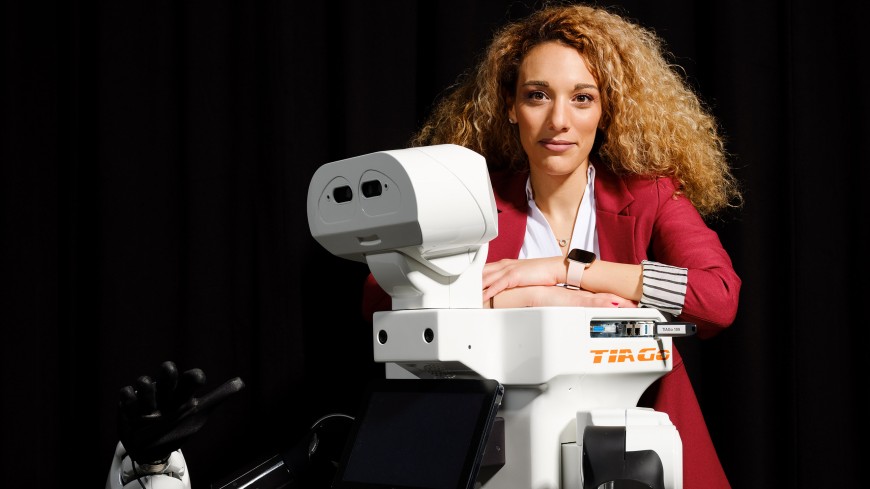
Picture: Katrin Binner Computer scientist Georgia Chalvatzaki receives the Alfried Krupp Prize 2025, endowed with 1.1 million euros.
ELIZA fellow Prof. Dr. Georgia Chalvatzaki (TU Darmstadt) has been awarded the prestigious Alfried Krupp Prize 2025, endowed with €1.1 million. One of Germany’s most significant scientific distinctions, the prize honors outstanding early-career researchers in their first professorship and underscores the societal relevance of their work.
Since 2023, Chalvatzaki has held the Professorship for Interactive Robot Perception and Learning at TU Darmstadt, where she leads the PEARL Lab. Her research advances robots that learn in real time through interaction—with environments and, crucially, with humans. This human-centered robotics approach reframes autonomy as collaboration: machines that adapt to us, rather than asking people to adapt to machines. The implications are wide-ranging, from more attentive healthcare support and responsive logistics to robust, sustainable agriculture.
Her trajectory reflects both scientific rigor and community impact. In 2024, Chalvatzaki received an ERC Starting Grant and was named an ELLIS Scholar in the European Lab for Learning and Intelligent Systems, aligning her work with Europe’s leading efforts in machine learning. As an ELIZA fellow, her research resonates deeply with our commitment to interdisciplinary, responsible AI that is not only performant but socially attuned.
At its core, Chalvatzaki’s work is a meditation on learning as shared practice: perception as dialogue, adaptation as care, and intelligence as something distributed across humans and machines. The Alfried Krupp Prize recognizes this vision and the promise it holds for safer, more responsive, and genuinely helpful robotic systems.